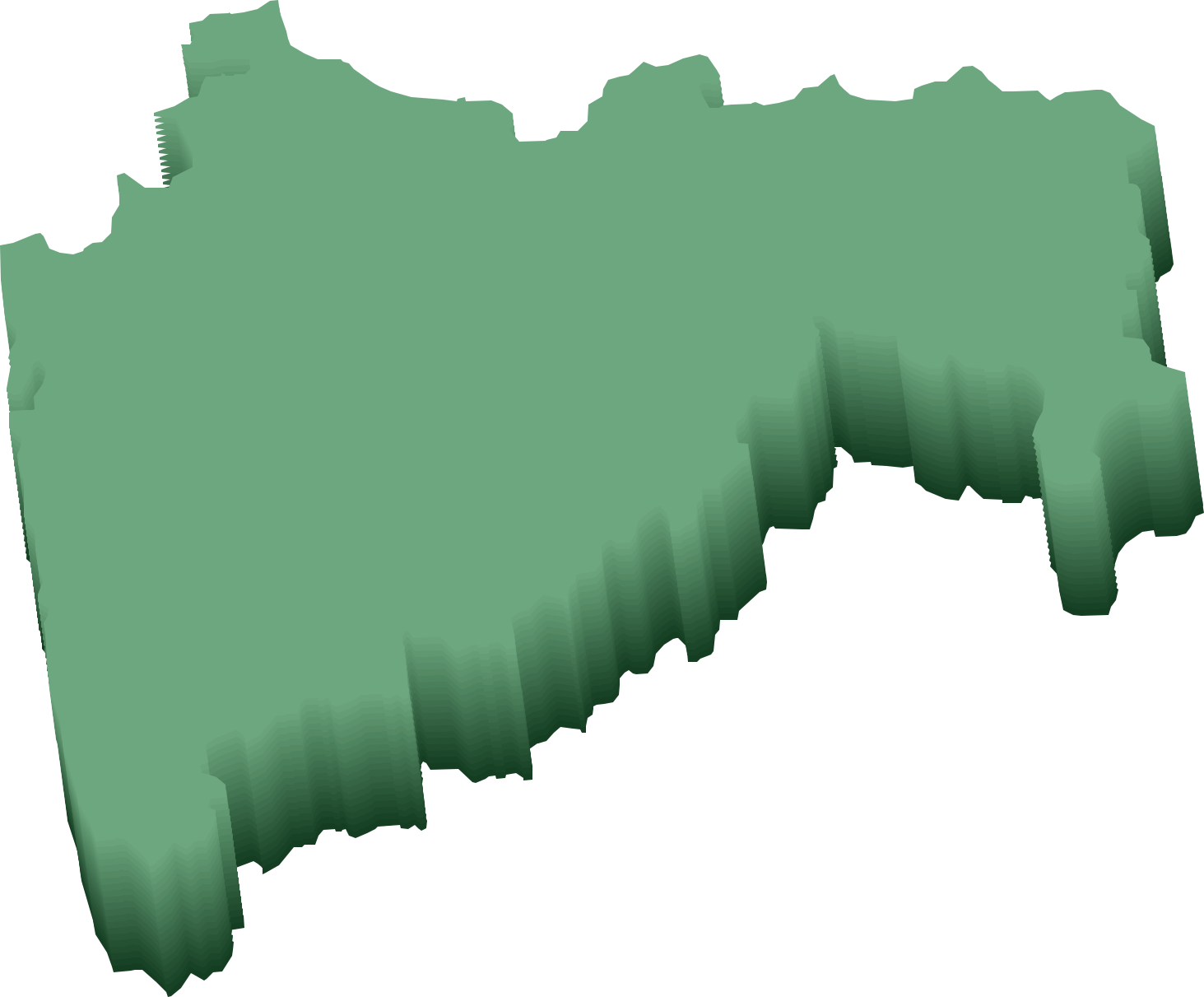
About Yavatmal District (Maharashtra)
Yavatmal district, a part of the Amravati division is a district of Maharashtra with its administrative headquarters located at Yavatmal city. Legends believe that during the era of Mahabharata, Yavatmal, along with earlier Berar province was a part of the famous Vidarbha kingdom. In the reign of Ashoka (272 to 231 BCE) also Berar was a significant part of the Mauryan Empire. During different periods of times the Berar region was ruled by different prominent dynasties namely the Satavahana dynasty (2nd century BCE-2nd century CE), the Vakataka dynasty (3rd to 6th centuries), the Chalukya dynasty (6th to 8th centuries), the Rashtrakuta dynasty (8th to 10th centuries), the Western Chalukya (10th to 12th centuries), and finally, the Yadava dynasty of Devagiri (late 12th to early 14th centuries). Then a period of Muslim rule was started when Alauddin Khilji, Sultan of Delhi came to the region and conquered it in the early 14th century. After sometime when the Bahmani Sultanate was separated from the Delhi Sultanate in the mid of the 14th century, the place of Berar automatically came under the rule of the Bahmani Sultanate. Later, the Mughals also captured it and ruled it for a definite period of time. In 1853, the British came to the place and started to rule over it. During their administration Berar was divided into East and West Berar with present day’s Yavatmal district being included in East Berar.
Kazi Syed Karimuddin, an illustrious member of the Constituent Assembly of India that framed the Indian Constitution was born on 19th July, 1899 in the Yavatmal district.
Geographically, the district lies at 20°39'N latitude, 78°12'E longitude and 445 m altitude. In the year 2023, there was a total 19.18% forest area of total geographical area. The district encompasses a geographical area of 13,582 sq km. and in terms of geographical area it occupies the ranks of 7th in the state and 26th in India. It is bounded by Amravati district and Wardha district on the North, Nanded district and Andhra Pradesh on the South, Chandrapur district on the East and Parbhani district and Akola district on the West. During the summer the climate of the district remains extremely hot. Most of its rainfall occurs in the monsoon season. The actual rainfall in the district was 1233.9 mm in the year of 2024-2025.
Administration wise, the district is divided into 16 tehsils namely Arni, Umarkhed, Kalamb, Pandharkawada Kelapur, Ghatanji, Zari Jamani, Darwha, Digras, Ner, Pusad, Babhulgaon, Mahagaon, Maregaon, Yavatmal, Ralegaon and Wani. Moreover, it comprises 18 towns and 1,853 villages. The administrative language in the district is Marathi.
According to 2011 census the district has a population of 27,72,348 out of which 14,19,965 are males and 13,52,383 are females. The district has a sex ratio of 952 females for every 1000 males. Furthermore, the district has an estimated projected population of 33,80,851 comprising 17,34,045 males and 16,46,806 females for the year 2026. According to the National Family Health Survey (NFHS-5, 2019–21), the district has an estimated sex ratio of 986 females and a child sex ratio of 990 females per 1,000 males. In the year 2001-2011 the population growth rate in the district was 12.78% including 12.19% are males and 13.40% are females. The population density in the district is 204 persons per sq. km. In the year 2023 the number of live births in the district was 43,376 out of which 22,596 were males and 20,780 were females. In the same year the number of deaths in the district was 17,543 out of which 10,633 were males and 6,910 were females. As per 2011 census the major religion in the district is Hindu with 81.21% of the total population. According to 2041 census the principal languages in the district are Marathi and Hindi with 67.57% and 19.00%.
Agriculture is the backbone of the economy of the district. Most of the lands in the district are use for agricultural purposes. More than half of its population are engaged in agriculture in order to earn their livelihood. The chief agricultural products in the district are cotton, teakwood, lime, oranges, etc. Yavatmal town is popularly known as "Cotton City". Both the cotton-ginning and pressing are carried on in the region of Yavatmal. The adoption of the new agricultural technologies amongst the farmers of the district helps to increase the production of various agricultural items. Industrially, also the district is quite well developed. The foremost industrial centres in the district are at MIDC Lohara, Darwha, Digras, Pusad, Umerkhed, Wani, Umari, Pandharkawada, Ralegaon and Babhulgaon. In 2006 the Ministry of Panchayati Raj declared Yavatmal as one of the country's 250 most backward districts and currently receiving funds from the Backward Regions Grant Fund Programme (BRGF). In the year 2023-2024 the Gross Domestic Product in the district was Rs. 54,89,900 lakh at current price and Rs. 32,51,900 lakh at constant 2011-2012 prices. The Net Domestic Product in the district during the period 2023-2024 was Rs. 48,48,100 lakh at current price and Rs. 28,47,400 lakh at constant 2011-2012 prices. The Per Capita Income or NDDP, At Factor Cost in the district during the period 2023-2024 was Rs. 1,60,088 at current price and Rs. 94,025 at constant 2011-2012 prices.
The district is well-known as an abode of several reputed educational institutions. It provides a platform for higher education. Some of its renowned educational institutions are namely Shri Vasantrao Naik Government Medical College, Government Polytechnic, Government Residential Women's Polytechnic, Jawaharlal Darda Engineering and Technical Institute, Dr. Bhausaheb Nandurkar College of Engineering and Technology, Jagdamba College of Engineering, etc. As per 2011 census the literacy rate in the district is 82.82% including 89.41% are males and 75.93% are females. In addition, according to the Periodic Labour Force Survey (PLFS) for the period July 2023-June 2024 estimated literacy rate in the district is 86.08% including 87.77% are males and 84.13% are females (Age 7 Years and Above).
Vasantrao Phulsing Naik, a veteran Indian politician who served as the 4th Chief Minister of Maharashtra from 1963 until 1975 was born on 1st July, 1913 at Pusad in the Yavatmal district.
The district has several centres of attraction which allures many travellers from different parts of the country as world. Borgaon Dam, located in the Yavatmal district is a popular spot in for relaxation. Every year many visitors from far distance places come to this place in order to spend some quality time with their families. Prerna Sthal, located in the Yavatmal city was constructed in the memory of freedom fighter and social activist named Jawaharlal Darda. The place is decorated with beautiful garden which spreads over 80,000 feet. Shardashram, an important History Research Institute of Yavatmal was founded by Dr. Y. K. Deshpande in 1932. The institute conducts many prominent researches in the field of ancient Indian history. Some other notable places of interest in the district are Tipeshwar Wildlife Sanctuary, Painganga Wildlife Sanctuary, Shri Ranganatha Swamy Mandir, Shri Chintamani Ganesh Mandir, Khateshwar Maharaj Temple, Mahadev Hemadpanthi Temple and many more.